Create sales territory maps from customer and account data
Sales territory planning in TerritoryKit starts with coordinate-ready customer, account, prospect, or branch data and turns it into editable territory zones.
Who this is for
This workflow is for sales operations teams, regional managers, account planners, and analysts who need to compare how records fall inside custom sales regions.
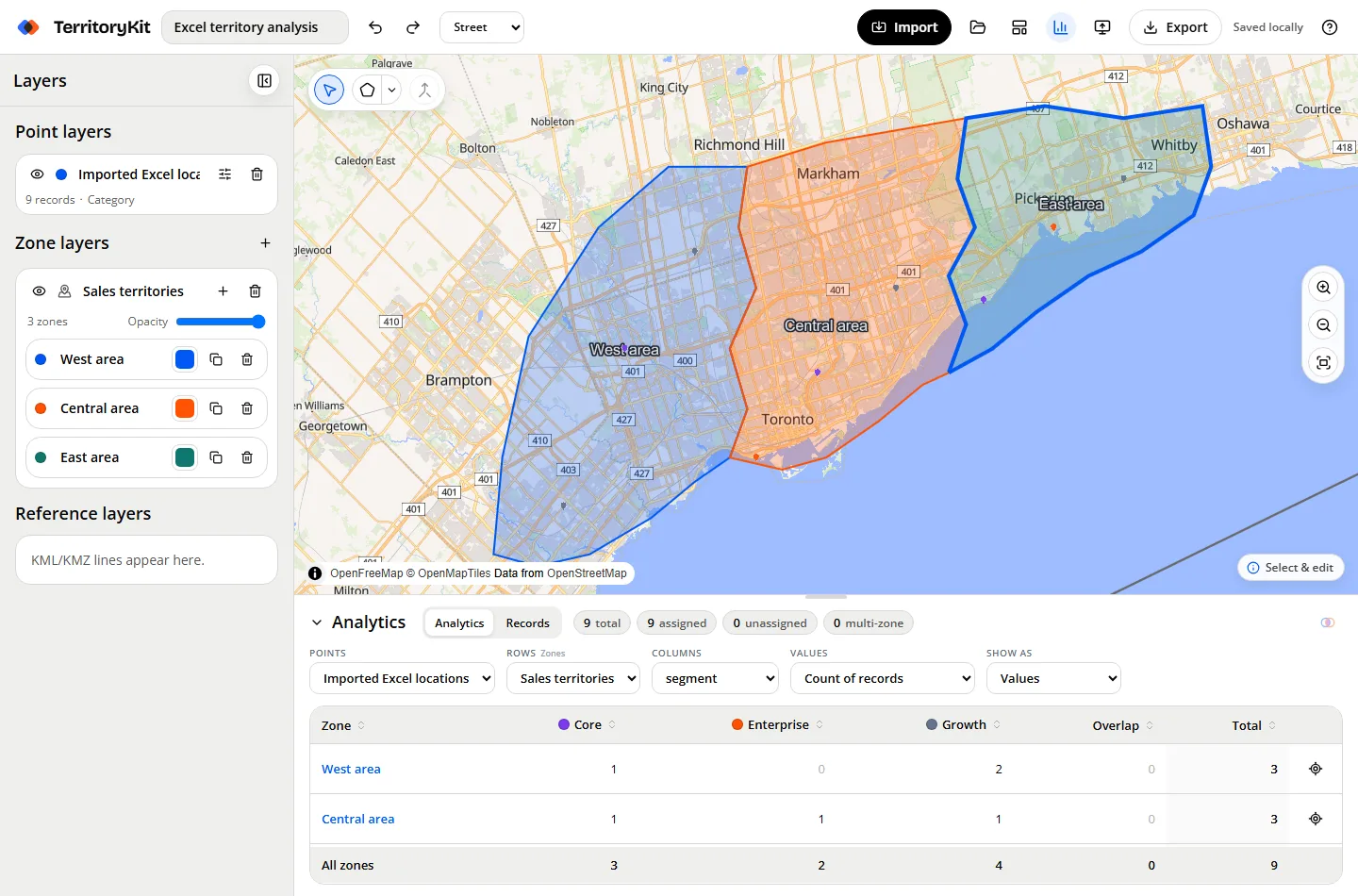
Step-by-step workflow
Import customer or account locations
Upload CSV, XLSX, or XLS files with latitude and longitude columns. Use fictional test data first if you want to learn the flow.
Draw sales territories
Create polygon or circle territories, or import existing KML/KMZ boundaries from another mapping tool.
Compare territory counts
Use analytics to review totals, unassigned records, and records that appear in more than one zone.
Export the plan
Export metrics, point membership, KML, GeoJSON, or a full project backup for continued editing.
Supported inputs
- CSV, XLSX, and XLS files with customer, account, prospect, or branch coordinates.
- KML or KMZ files for existing sales territory boundaries.
- Optional fields such as segment, status, owner, priority, or region.
Tips and common mistakes
- Confirm every spreadsheet point has valid latitude and longitude values.
- Remove empty rows before importing CSV or Excel files.
- Use readable headers so layer styling and group-by options are easier to understand.
- Check for points outside every zone before exporting results.
- If imported KML/KMZ boundaries do not appear, confirm the file contains supported geometry.
Export and results
Export metrics as CSV or Excel, point membership as CSV or Excel, zone geometry as GeoJSON or KML, and a portable project backup for later editing.
Current limitations
TerritoryKit does not automatically balance territories, assign reps, geocode addresses, forecast revenue, or sync with CRM systems.
FAQ
Can I plan territories from an Excel account list?
Yes, if the workbook includes latitude and longitude columns.
Can I see which accounts are in overlapping sales regions?
Yes. Analytics includes records that fall in more than one zone.
Can I export territory results for reporting?
Yes. Export metrics and membership as CSV or Excel.
Can I use existing KML boundaries?
Yes. Import KML or KMZ boundaries and compare them with your point layer.
Related guides
Build your first territory map
Bring your coordinates, draw the zones you need, and see the results as the map changes.
Open Map Builder